
For years, organizations operated comfortably with SSL/TLS certificates that remained valid for over a year. Certificate renewals were infrequent, spreadsheets were considered sufficient for tracking expirations, and manual processes were often enough to maintain compliance.
That reality has changed.
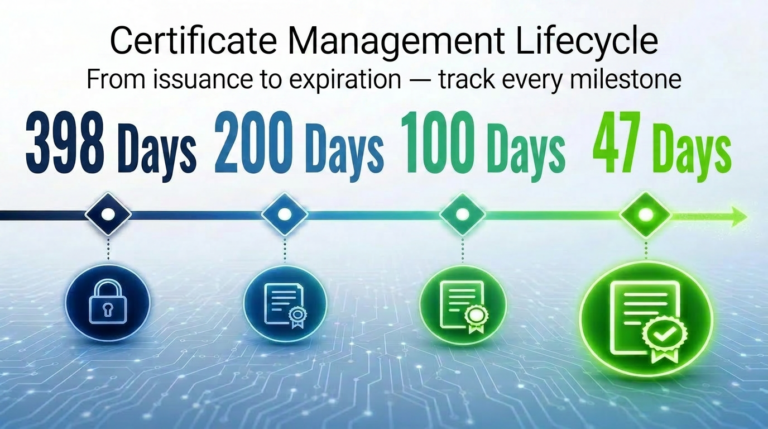
The CA/Browser Forum has approved a phased reduction in public TLS certificate validity periods, creating one of the most significant operational shifts the industry has seen in decades. Organizations that previously renewed certificates annually must now prepare for increasingly frequent renewal cycles:
- Until March 2026: 398-day certificate validity
- March 15, 2026: Reduced to 200 days
- March 15, 2027: Reduced to 100 days
- March 15, 2029: Reduced to just 47 days
While these changes improve security by reducing the exposure window of compromised certificates and outdated cryptographic assets, they also introduce a new operational challenge: managing digital certificates at scale.
The Operational Impact on Enterprises
A company managing 500 certificates today may only process a few hundred renewal activities annually. Under a 47-day validity model, that same organization could face thousands of certificate lifecycle events every year.
Without centralized visibility and automation, IT and security teams risk:
- Unexpected certificate expirations
- Application and service outages
- Compliance failures
- Increased operational overhead
- Delayed business initiatives
The challenge is no longer acquiring certificates. The challenge is managing their entire lifecycle efficiently.
Why Traditional Certificate Management Approaches Are Failing
Many Organizations depend on:
- Manual certificate inventories
- Spreadsheet-based tracking
- Decentralized ownership
- Reactive renewal processes
These methods become increasingly difficult to sustain as certificate lifecycles continue to shrink.
As renewal frequency increases, even a single missed certificate can result in downtime, customer impact, and reputational damage.
Preparing for the 100-Day and 47-Day Future
Preparing for the 100- Day and 47- Day Future
Organizations should focus in four critical areas:
1. Certificate Discovery
Establish complete visibility into all certificates across cloud, on-premises, hybrid, application, and network environments.
2. Centralized Governance
Define ownership, renewal policies, certificate standards, and compliance requirements across the enterprise.
3. Automation
Implement automated discovery, issuance, renewal, deployment, and monitoring processes to reduce operational risk.
4. Crypto Agility
Build the ability to quickly adapt to evolving cryptographic standards, regulatory requirements, and future certificate lifecycle changes.
How We Help
At Like Minds Consulting, we help organizations establish a modern Certificate Lifecycle Management strategy that aligns with evolving industry requirements.
Our consultants work with customers to:
- Assess current certificate management maturity
- Discover and inventory certificate assets
- Design governance frameworks
- Implement automated lifecycle management processes
- Integrate certificate management across enterprise applications and infrastructure
- Reduce operational risk while improving security and compliance
As certificate validity periods continue to decrease, organizations require more than just certificate issuance. They need visibility, governance, automation, and expert guidance.
The Time to Prepare is Now
The move from 398-day certificates to 200 days has already begun. The transition to 100 days in 2027 and 47 days in 2029 will place even greater pressure on organizations that continue to rely on manual processes.
The organizations that act now will be best positioned to avoid outages, reduce operational burden, and maintain trust across their digital infrastructure.
Certificate lifecycle management is no longer an operational convenience—it is becoming a business necessity.
Contact Like Minds Consulting to learn how your organization can prepare for the next phase of certificate lifecycle management.