
By now, the problem should feel familiar. Certificates are now expiring every 47 days instead of 398 — and if you cannot secure what you cannot see, it is certainly difficult to manage what you do not know exists.
The move to shorter certificate lifetimes made one thing clear: waiting is no longer a strategy.
Our previous post looked at why certificate validity periods are shrinking. Then we looked at certificate discovery and why visibility has to come first.
Now comes the important question:
Once you know what you have, what do you actually do with that information?
That is where certificate lifecycle management comes in.
And it is not about buying another tool and checking a box.
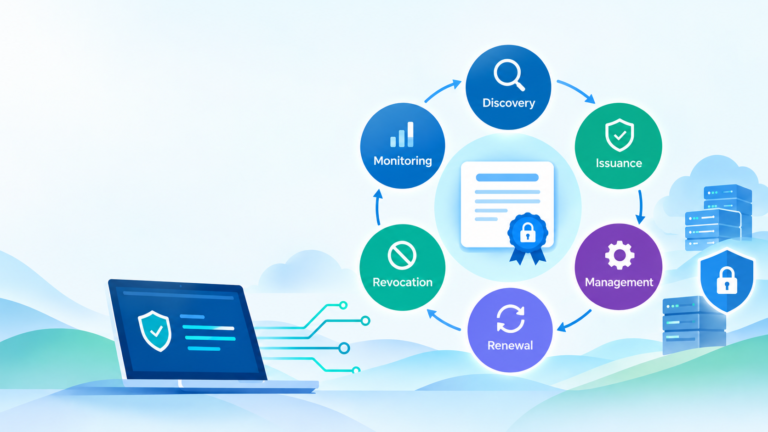
It is about building a process that works continuously — from the moment a certificate is requested, through issuance, deployment, monitoring, renewal, and eventually revocation and retirement.
The organizations that do this well do not treat certificate management as an annual exercise. They treat it as an ongoing operational process.
Here’s what that looks like in practice.
Step 1: Discovery Is the Foundation, Not the Finish Line
If you have read our post on certificate discovery, you already know that discovery — scanning your network, cloud environments, endpoints, and load balancers for every certificate in use — is where any real strategy has to start. But discovery is only valuable if it feeds into something ongoing.
Discovery cannot be a one-time activity.
A scan today gives you a snapshot of your environment. Tomorrow, someone might deploy a new application, create a new subdomain, spin up a cloud workload, or provision another certificate.
Your environment is constantly changing. Your certificate inventory needs to keep up.
The goal is not simply to create a long list of certificates.
The goal is to build a living inventory that tells you:
- What certificates do we have?
- Where are they being used?
- Who owns them?
- When do they expire?
- Which CA issued them?
- What applications or services depend on them?
- What happens if they aren’t renewed?
That information becomes the foundation for everything that follows.
Step 2: Centralize Visibility Across Teams
Certificates rarely belong to just one team.
DevOps may provision them. Security may define the policies. Infrastructure teams may deploy them. Application owners may depend on them. And when something expires, the business may be the one dealing with the outage.
When every team maintains its own spreadsheet or monitoring process, things quickly become difficult to manage.
One team thinks a certificate is covered.
Someone else owns the application but does not know who owns the certificate.
And suddenly, an expiration becomes an incident.
A centralized inventory creates a single source of truth.
Everyone can see the same certificate, the same expiration date, the same owner, and the same risk level.
This is more than improving visibility. It creates accountability.
Step 3: Standardize Issuance and Renewal Policy
Once you know what you have and who owns it, it’s time to define the rules.
Which Certificate Authorities are approved?
Which validation methods should be used?
What key sizes and algorithms are required?
Where can certificates be issued?
How should wildcard certificates be handled?
What happens when a team needs an exception?
These decisions should be made before automation is introduced.
Otherwise, you risk automating inconsistent processes — which simply means you can make mistakes faster.
This is also where shorter certificate lifetimes need to change the mindset.
With certificates moving toward 47 days and potentially shorter lifetimes, frequent renewal should not be treated as an unusual event.
It should become the normal operating model.
Step 4: Automate Renewal
This is where the strategy actually earns its name. Manual renewal, even with reminders and calendar alerts, cannot keep pace with certificates that expire every month and a half across hundreds or thousands of endpoints. Automation, typically via protocols like ACME, removes the human bottleneck entirely: certificates are requested, validated, issued, and deployed without anyone needing to remember a deadline.
The teams that succeed here do not automate everything at once. They start with high-volume, low-risk certificate types, prove the process works, and expand from there — building confidence before extending automation to more sensitive systems.
Step 5: Monitor Continuously and Alert Early
Automation reduces manual work, but it doesn’t mean you can stop watching.
Renewals can fail.
DNS configurations can change.
Validation challenges can fail.
A certificate may renew successfully but fail to deploy.
A certificate could be installed in the wrong location.
This is why monitoring remains a critical part of the lifecycle.
Don’t wait for the “certificate expires tomorrow” alert.
You want visibility into the health of the entire process — including upcoming expirations, failed renewals, deployment problems, configuration issues, and certificates that don’t meet policy.
The earlier you know something has gone wrong, the more options you have to fix it.
Step 6: Plan for Revocation and Retirement
There is another part of certificate management that doesn’t get enough attention:
What happens when a certificate is no longer needed?
Certificates do not only expire.
Keys can be compromised. Employees can leave. Applications can be decommissioned. Domains can change. Infrastructure can be replaced.
In these situations, certificates may need to be revoked and removed.
A mature lifecycle strategy therefore doesn’t stop at renewal.
It includes revocation, replacement, and retirement as well.
When these processes are built into the same workflow, organizations can reduce the number of forgotten or unnecessary certificates sitting in their environment.
Step 7: Measure What is Improving
Once the lifecycle is in place, there is one more question worth asking:
Is it actually working?
Good certificate management should be measurable.
Organizations can track things such as:
- Number of certificates discovered
- Certificates without assigned owners
- Certificates approaching expiration
- Percentage of certificates automatically renewed
- Failed renewal attempts
- Certificates outside approved policy
- Time spent on manual certificate management
- Number of certificate-related incidents
These metrics help turn certificate management from a reactive IT task into something that can be continuously improved.
Turning Strategy Into Action
Building a certificate lifecycle strategy is one thing. Putting it into practice across a real-world environment is another.
This is where LikeMinds Consulting can help.
As a DigiCert Managed Service Provider (MSP) Partner, LikeMinds helps organizations move beyond manual certificate tracking and build a more structured, automated approach to certificate lifecycle management.
That can include helping organizations:
- Discover and inventory certificates across on-premises, cloud, and hybrid environments
- Establish centralized visibility into certificate ownership, usage, and expiration
- Define certificate policies and governance aligned with organizational and security requirements
- Automate certificate issuance and renewal to reduce dependence on manual processes
- Monitor certificate health and renewal activity before issues become outages
- Manage certificate replacement, revocation, and retirement as part of the broader lifecycle
- Scale certificate management as applications, workloads, domains, and cloud environments continue to grow
We help teams build a certificate management process that is repeatable, scalable, and easier to operate — especially as certificate lifetimes continue to shrink.
Bringing It All Together
None of these six steps work in isolation. Discovery without centralization just creates a longer spreadsheet. Policy without automation is aspirational. Automation without monitoring is a black box you’re hoping stays quiet. The organizations that handle certificate management well treat it as one continuous system — visibility feeding policy, policy feeding automation, automation feeding monitoring, and monitoring feeding back into discovery as new assets appear.
The real value comes when everything works together:
Discovery → Visibility → Ownership → Policy → Automation → Monitoring → Revocation & Retirement
And then the cycle starts again as new certificates and new workloads enter the environment.
That’s the real shift in certificate lifecycle management.
The shift from 398-day to 47-day certificates is not a temporary inconvenience to work around. It is a signal that the entire discipline is moving toward shorter cycles and less tolerance for manual processes. A real lifecycle management strategy is how you get ahead of that shift instead of reacting to it one expired certificate at a time.
The organizations that get ahead of this won’t be the ones with the biggest spreadsheet or the most reminders on their calendars.
They will be the ones that build a continuous, automated, and accountable certificate lifecycle.
Because the goal is not simply to prevent the next certificate outage.
It is to build a certificate management process where outages caused by certificate expiry become increasingly difficult to happen in the first place.