
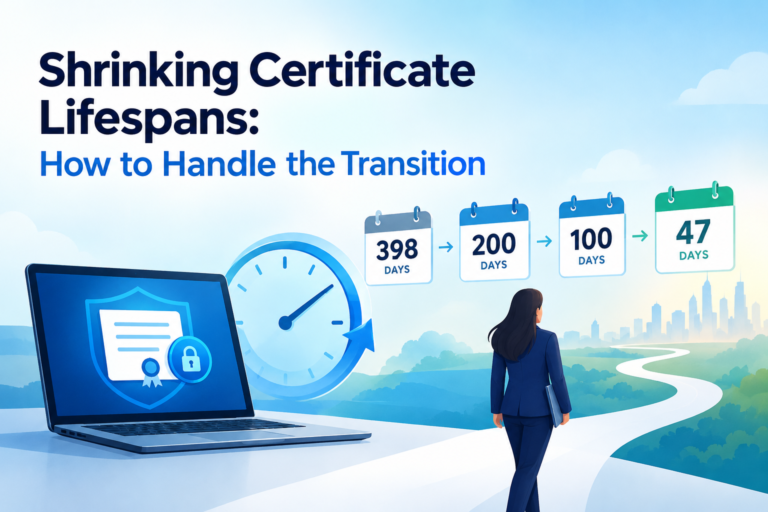
The shift from 200 days to 47 days is coming. Shorter lifespans fix major security risks, but they also multiply your team’s workload.
Knowing why it is happening is easy. Surviving the operational shift is where most teams struggle.
Here is the 4-step roadmap to transition smoothly without breaking your operations.
1. Uncover Shadow PKI
You can’t automate what you can’t see.
- The Problem: Years of cloud expansion leave forgotten certificates in DevOps pipelines, legacy web servers, and third-party tools.
- The Fix: Run automated network discovery to map every public and private certificate into one centralized inventory.
2. Eliminate Manual Bottlenecks
Moving from annual renewals to every few weeks exposes every delay in your process.
- The Problem: Manual domain validation (DCV), slow change control approvals, and manual server restarts will grind IT to a halt.
- The Fix: Fast-track approval policies for automated rotations and replace manual steps with auto-rebinding.
3. Move beyond custom scripts
Custom shell scripts break quietly when engineers leave or APIs change.
- The Problem: “In-house scripts” are a ticking time bomb for expired certificates.
- The Fix: Standardize on ACME (Automated Certificate Management Environment) and ARI (ACME Renewal Information) for reliable, hands-off renewals.
4. Shift to Managed Automation
The goal is zero human touch for standard renewals.
With Like Minds + DigiCert Trust Lifecycle Manager, your team stops chasing expiration dates:
- Continuous discovery across cloud and on-prem
- Automated issuance and binding with no manual steps
- Real-time monitoring to catch issues before an outage happens
Start the Transition Today
Shortening certificate validity isn’t something you can fix overnight in a rush. The teams that automate now will transition smoothly.