
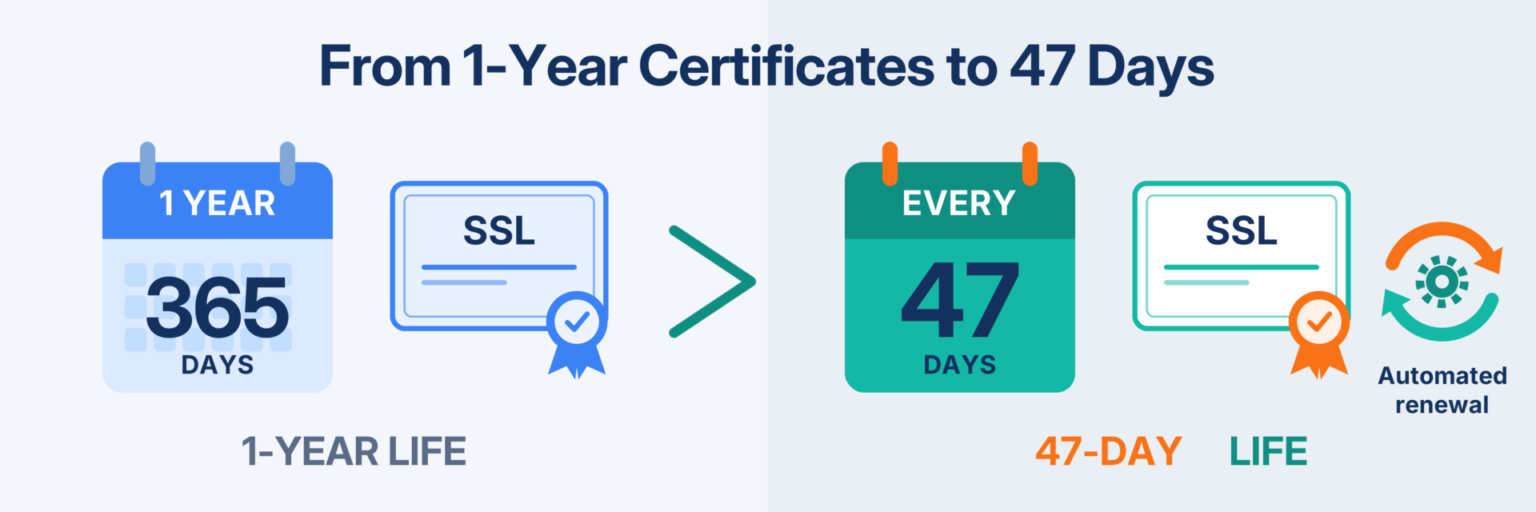
In our previous 2 blogs, we explored why TLS certificate lifespans are shrinking and why organisations need to start preparing for the transition.
But what does this change actually mean for your IT and security teams?
Let’s look at a practical scenario.
Imagine your organisation manages 1,000 digital certificates.
With a 398-day validity period, you are looking at approximately 900 renewals a year. That’s around 2–3 renewals a day.
With 47-day certificates, that number increases to approximately 7,800 renewals a year – or 21 renewals every single day.
And that’s assuming everything goes according to plan.
The challenge isn’t simply renewing certificates more frequently. It’s managing every stage of the certificate lifecycle without introducing operational delays, security gaps or service disruptions.
Nothing about the renewal process itself is new. What is new is how often it runs.Here is how the load moves through your organization.
1. Discovery: Do you know where all your certificates are?
You cannot renew certificates you don’t know exist.
Certificates often sit across servers, applications, cloud environments, load balancers and development systems. An incomplete inventory that might have gone unnoticed with annual renewals can quickly become a problem when certificates expire every few weeks.
The risk: An overlooked certificate becomes an unexpected expiration and potentially an application outage.
2. Ownership: Who is responsible for this certificate?
Every certificate needs an owner.
But when teams change, employees move on and applications are transferred, ownership information can become outdated. Without clear accountability, even identifying who needs to approve or action a renewal can take valuable time.
The risk: Renewals get delayed because nobody knows who is responsible.
3. Renewal: Is there enough time to get it approved?
With shorter certificate lifespans, renewal windows become much tighter.
If your team starts the renewal process around two-thirds into a 47-day lifecycle, that leaves approximately 16 days before expiration.
A delayed approval, change freeze, holiday or manual intervention can consume that window.
The risk: A routine renewal turns into an urgent escalation.
4. Deployment: Has the renewed certificate actually been installed?
Getting a new certificate issued is only part of the process.
It still needs to be deployed across the relevant applications, servers, load balancers and other infrastructure components.
When deployment depends on manual hand-offs, there is always a possibility that the old certificate remains in use.
The risk: The certificate is renewed, but the application continues serving an expired one.
5. Validation: Are the prerequisites still in place?
Certificate issuance often depends on domain control validation (DCV).
As validation reuse periods become shorter, organizations may need to repeat validation activities more frequently. Manual DNS updates, email approvals and coordination between teams can add further delays.
The risk: Certificate issuance gets held up by processes that cannot keep pace with the new timelines.
6. Monitoring: Do you know what is expiring next?
A reminder to check certificates 30 days before expiration may have worked when certificates lasted a year.
With a 47-day validity period, that approach is no longer sufficient.
Organizations need continuous visibility into certificate status, expiration dates and deployment. It is equally important to verify that the renewed certificate is actually installed and being served.
The risk: Problems go unnoticed until an application or service is affected.
7. Incident Handling: What happens when a renewal fails?
With renewals happening every day, occasional failures are inevitable.
The difference is how quickly your team identifies and responds to them.
Without automated alerts, visibility and remediation workflows, IT teams can spend valuable time investigating expired certificates and resolving preventable outages.
The risk: More firefighting, more service disruptions and less time for strategic IT initiatives.
The Bigger Picture: It is not just about shorter certificates. It is about operational readiness.
None of these seven stages is new. What changes is how frequently your organization needs to execute them.
A process designed around a handful of annual renewals may struggle when the same infrastructure requires thousands of renewals every year.
The question is no longer simply whether your team can renew a certificate.
Can your organization discover, track, renew, deploy and validate thousands of certificates throughout the year without missing a deadline?
That is where certificate lifecycle automation becomes essential.
How LikeMinds and DigiCert Can Help
LikeMinds Consulting, a DigiCert partner, helps enterprises simplify certificate lifecycle management through DigiCert Trust Lifecycle Manager (TLM).
Our managed certificate lifecycle services help organizations:
- Discover and maintain visibility of certificates across their environments.
- Automate certificate issuance, renewal and deployment workflows.
- Monitor certificate status and expiration dates.
- Improve operational visibility and reduce manual intervention.
- Support compliance and certificate governance requirements.
Prepare your certificate infrastructure for shorter lifespans before they become an operational challenge.
Book a 30-Minute Certificate Inventory Review